

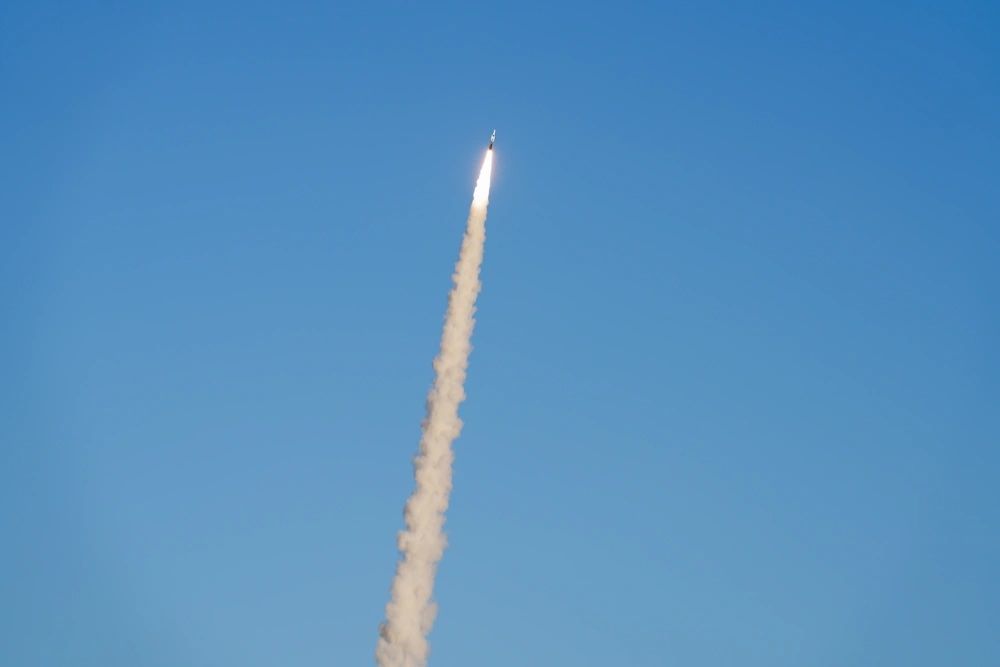
During large-scale military drills in northern Australia, the U.S. Army successfully conducted its inaugural live-firing of a new Mid-Range Capability (MRC) missile system in the Pacific. The test took place during Talisman Sabre 25, a joint U.S. and Australian exercise.
An SM-6 missile, launched from the new system, struck and sank a maritime target, as confirmed by the Army. This successful execution marks a significant advancement in the U.S. military’s ability to deploy, integrate, and command advanced land-based maritime strike capabilities, according to Col. Wade Germann, commander of the Army’s 3rd Multi-Domain Task Force.
The exercise served to validate targeting and command and control cooperation with the Australian military. Col. Germann emphasized that this achievement sets the stage for developing and deploying combat-credible, multidomain capabilities forward, supporting the combined and joint force.
This missile firing follows earlier Chinese naval live-fire drills near Australia in February, which drew criticism from Canberra due to a lack of prior notification. These Chinese drills led to flight diversions. Additionally, Chinese warships had previously circumnavigated Australia around the same period.
The new MRC system, sometimes referred to as Typhon, is capable of launching both precision-guided SM-6 missiles and long-range Tomahawk cruise missiles. The SM-6 has an approximate range of 300 miles, while the Tomahawk can reach targets up to 1,200 miles away.
Its initial overseas deployment to Luzon in the Philippines earlier in 2024 triggered opposition from China, given the missiles’ potential to engage Chinese ships in the South China Sea and military installations on Chinese territory.
Military experts view this new weapon as a crucial element of an updated U.S. strategy aimed at strengthening long-range attack capabilities to effectively counter China’s extensive buildup of intermediate-range and long-range missiles in the Pacific. The U.S. military previously focused primarily on defending against Chinese missiles.
The MRC test firing coincides with Australia’s October announcement of a $7 billion investment to acquire SM-6 multimission missiles, along with SM-2 anti-ship missiles. Australia has also committed to purchasing 200 Tomahawk missiles, and Japan intends to acquire 400 Tomahawks.
Both the SM-6 and Tomahawk missiles are compatible with the new MRC system.
The Navy’s Standard Missile-6, initially developed by defense contractor Raytheon as an anti-missile interceptor, has since been adapted for multiple roles, including engaging aircraft, drones, and cruise missiles, as well as serving as a surface-to-surface and anti-ship missile.
The Army also asserts that the MRC possesses some capability to intercept Chinese hypersonic maneuvering missiles.
The Army has hailed the recent missile launch as a significant milestone for land-based maritime strike and strategic strike capabilities within the U.S. military, as part of the service’s long-range precision fires program.
The Army stated, “This was the first time that a land-based MRC has been fired west of the international date line, marking a significant milestone in the development and employment of the U.S. military’s land-based maritime strike capabilities.”
The containerized missile launcher used for the MRC is based on the Navy’s MK 41 launcher, which is typically found on warships.
The Army provided no further details regarding the target ship or the precise location of the SM-6 launch, other than to confirm that it took place in northern Australia.
It appears that the missile system was transported to Australia via cargo aircraft for the purpose of these exercises.
In the past, China threatened unspecified retaliatory actions if the MRC was not removed from the Philippines. Consequently, the missile system was relocated from northern Luzon to an alternative location within the Philippines.
In a related development, the aircraft carrier USS George Washington and the British carrier HMS Prince of Wales conducted joint operations during Talisman Sabre, occurring shortly after the missile test. This marked the first instance of the two nations’ carriers operating together in the annual exercise. Both carriers are equipped with the new F-35 stealth fighters.
Recently, U.S. Marines and Australian soldiers engaged in exercises focused on seizing remote airfields as part of Talisman Sabre, preparing for potential future operations in the region. Prior to that, the Marines and Australians executed an airborne raid to secure a town, utilizing V-22 Osprey transports.
Marine Corps Capt. Kendall Weigand, a KC-130J pilot with Marine Aerial Refueler Transport Squadron 153, noted that flying deep into the outback presented a unique experience for many Marines. “It’s wide open, wild terrain that’s unique to Australia,” he commented. “We dropped into a canyon and saw a herd of wild horses. We were hoping for kangaroos.” The exercises are scheduled to continue.
