

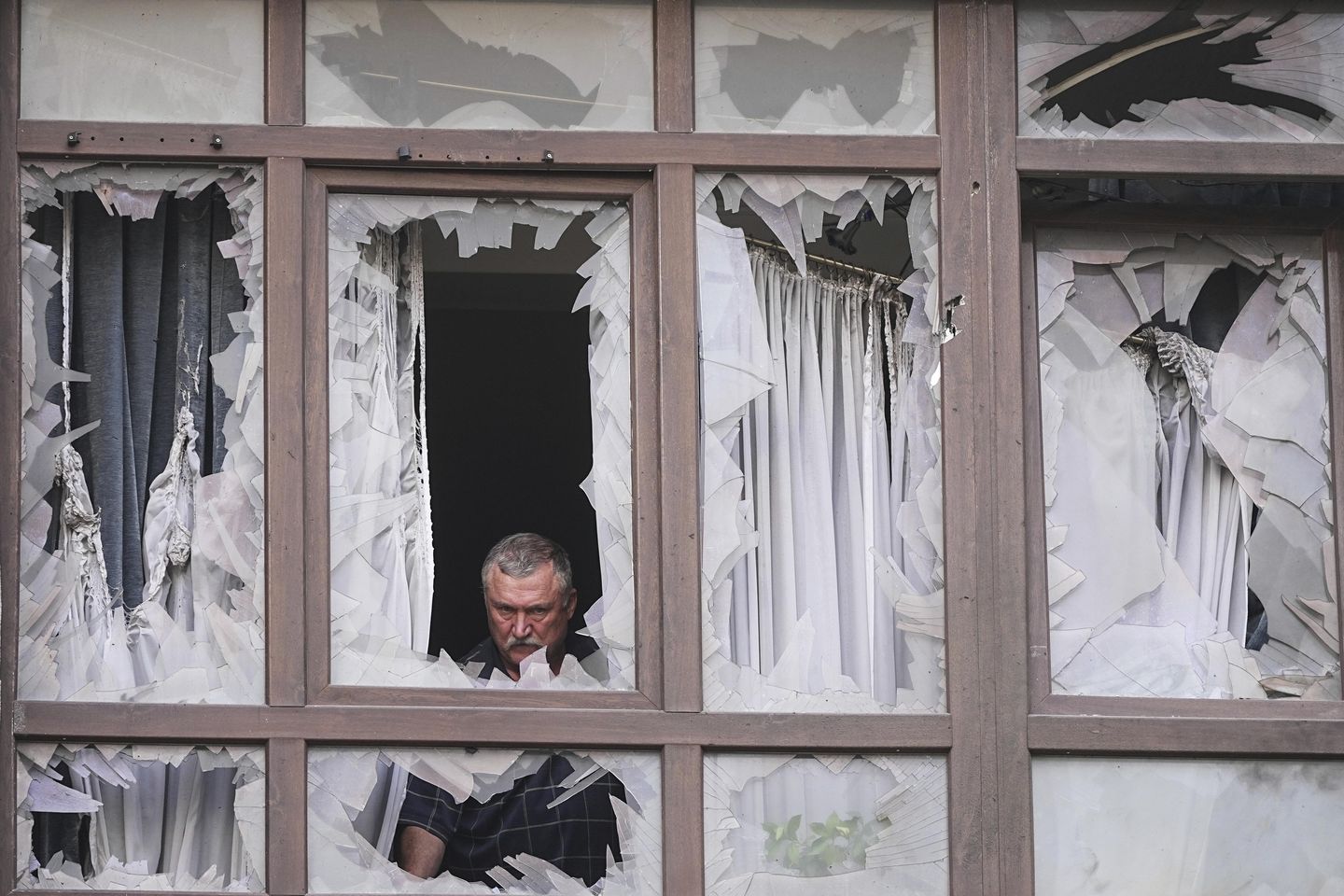
On a recent Sunday night, civilians across Ukraine were once again forced to seek refuge in shelters as air raid sirens blared, signaling another significant Russian aerial assault.
By Monday morning, the extent of the attack became clear: Moscow had launched a massive wave of 426 Shahed-type explosive drones and 24 missiles, targeting civilian and urban areas and causing widespread destruction across multiple regions. In Kyiv, the capital city, Russian drones struck a metro station, a residential building, and even a kindergarten.
“Kyiv Mayor Vitali Klitschko reported that a 12-year-old child was among the injured, describing the barrage as one of the worst the capital had faced in months.”
The intense attack prompted a swift response from Washington, signaling to Ukraine, its European allies, and, perhaps most importantly, to Russian President Vladimir Putin, that the ongoing bombardments of civilians in Kyiv and other Ukrainian cities had garnered the attention of the Trump administration.
Defense Secretary Pete Hegseth participated in a virtual meeting of approximately 50 countries supporting Ukraine on Monday afternoon, a notable shift considering his absence from the previous meeting of the Ukraine Defense Contact Group in June, when President Trump was actively pursuing a peace deal with Mr. Putin.
President Trump has reportedly expressed growing frustration with the Russian leader, whose continued escalation of assaults on Ukraine appears to defy the U.S. president’s attempts at de-escalation.
In response, President Trump recently threatened to impose significant “secondary” tariffs on Moscow and issued a 50-day ultimatum to Mr. Putin to reach a ceasefire agreement with Ukraine.
Despite the ongoing conflict, peace talks between Ukraine and Russia are scheduled to take place in Istanbul on Wednesday, according to Ukrainian President Volodymyr Zelenskyy. However, the Kremlin has indicated that the two countries remain “diametrically opposed” on the terms for ending the war. Previous negotiation attempts have only resulted in a prisoner swap.
The recent attack on Kyiv, which lasted for an extensive 10 hours and resulted in two fatalities, is part of a larger and increasingly intense Russian bombing campaign that has expanded both in scope and lethality in recent weeks. Ukrainian air defense systems, already facing ammunition shortages and overwhelmed by the sheer number of incoming threats, are struggling to effectively contain the onslaught.
“Russia’s attacks are always against humanity,” President Zelenskyy stated on Telegram on Monday, highlighting the targeting of civilian infrastructure such as a kindergarten, residential buildings, and other structures in Kyiv.”
The timing of the attack has raised concerns about Moscow’s true intentions, particularly as Ukrainian and foreign officials were scheduled to meet in Kyiv. French Foreign Minister Jean-Noel Barrot, who witnessed the devastation caused by the airstrikes, called for increased international pressure on Russia.
“Russia after witnessing the destruction caused by the airstrikes.”
“The massive package of sanctions we adopted at the European level last Thursday is welcome,” Mr. Barrot stated. “It increases pressure on Vladimir Putin, increases the cost of this unbelievable war.”
Military analysts have identified a concerning shift in Russia’s strategic approach. In recent months, the Kremlin has transitioned from sporadic missile attacks to large-scale, drone-swarm bombardments, facilitated by a significant increase in domestic drone production.
Mykola Bielieskov, a military analyst and research fellow at Ukraine’s National Institute for Strategic Studies, described this change as marking a “new and more dangerous phase” in the war.
Towards the end of last year, Russia was launching approximately 2,000 drones per month. This number has since more than doubled, exceeding 4,000, according to Mr. Bielieskov. He noted that it is now common for Russia to launch hundreds of drones in a single night. Many of these drones, now manufactured domestically, have been upgraded with artificial intelligence navigation systems, video targeting capabilities, and thermobaric warheads, effectively doubling their explosive payload to around 200 pounds.
Furthermore, Russia’s move towards full domestic production has been supported by technology transfers from Iran and, according to Ukrainian officials, has benefited from technical support from China and labor assistance from North Korea.
Beijing is allegedly supplying critical components, while Pyongyang is reportedly preparing to send workers to drone manufacturing facilities in eastern Russia.
Consequently, Russia’s drone penetration rate into Ukrainian airspace has nearly tripled. Reports indicate that approximately 15% of the drones successfully breached Ukraine’s defenses and reached their intended targets between April and June, compared to only 5% in the first quarter of the year. These coordinated attacks often combine drones with ballistic and cruise missiles, creating a saturation tactic designed to overwhelm Ukrainian air defenses.
Despite recent announcements of additional military aid, Ukraine’s partners have been slow to respond effectively. While President Trump has pledged to provide Patriot air defense systems, the financial burden of these systems is expected to fall on European and NATO allies, rather than the United States.
“Though 17 Patriot systems seems to be the number floated around, there is little to actually back that up at the time,” one expert noted. “Germany will pay for two systems and Norway for one, but who will pay for the other 14 remains an open question.”
Ukrainian Defense Minister Denys Shmyhal urged allies at the virtual meeting on Monday to expedite the delivery of American air defense systems.
“I request the U.S. to make these weapons available for purchase, and our European partners to extend all the needed financing for their procurement,” Mr. Shmyhal stated.
While Patriot systems are crucial for intercepting missiles, they are not effective against Shahed drones. Ukraine urgently needs interceptor drones, as drone attacks now involve hundreds of drones per attack, coupled with AI technology, new flight patterns, and increased explosives. The production and delivery of interceptor drones and systems on a large scale is essential.
Ukrainian air defenses currently rely on a mix of Soviet-era guns, short-range systems, and expensive Western-supplied missiles, forming a layered approach that is becoming increasingly unsustainable.
Cheap and mobile interceptor drones are considered the most cost-effective solution. While some are being developed by Ukraine’s defense tech sector, the large-scale deployment of such systems remains several months away.
“There is no time to waste,” Mr. Bielieskov emphasized. “Kyiv’s partners can contribute by supplying interceptor drones and financing the manufacture of domestic models.”
Ukraine has responded to the intensified drone warfare by increasing the frequency of its long-range strikes targeting Russian airfields. Ukrainian drones recently attacked facilities near Moscow, leading to temporary airport closures and disruptions to civilian air traffic.
On Monday, Russia’s Defense Ministry claimed to have shot down 117 Ukrainian drones, including 30 near the Russian capital.
However, these strikes, while symbolically significant, are unlikely to deter Moscow’s escalating campaign. Russia has relocated much of its drone infrastructure away from the front lines, making pre-launch destruction nearly impossible. Furthermore, drones do not require fixed airfields, complicating retaliatory actions.
As Russia’s bombing campaign becomes more sophisticated and deadly, the outcome of the war increasingly depends on the ability of Ukraine and its Western partners to adapt quickly to the evolving threat.
