

A ceasefire has been agreed upon between Israel and Syria, according to the U.S. envoy to Syria, following Israel’s intervention in the conflict between Syrian government forces and Bedouin tribes, along with armed groups from the Druze minority.
The announcement arrives amidst ongoing clashes between Druze and Bedouin clans in Syria’s southern Sweida province, which has led to a worsening humanitarian crisis with tens of thousands displaced.
Earlier in the week, government forces had withdrawn from Sweida after a separate ceasefire was agreed with Druze groups. This occurred after Israel launched multiple airstrikes targeting convoys of government fighters, even striking the Syrian Defense Ministry headquarters in central Damascus.
Israel stated that its actions were aimed at defending the Druze community, who are a substantial minority within Israel and are generally seen as loyal, often serving in the Israeli military.
The U.S. envoy shared that the new ceasefire between Israel and Syria has the support of Turkey, Jordan, and other neighboring countries. He also called for “Druze, Bedouins, and Sunnis to put down their weapons and together with other minorities build a new and united Syrian identity in peace and prosperity with its neighbors.”
Details of the agreement were not immediately provided.
Prior to the ceasefire announcement, Syria’s interim President had stated that the government would deploy a “specialized force to break up clashes and resolve the conflict on the ground” in Sweida.
Syrian officials had reportedly negotiated with Druze factions to reach an agreement that would allow government forces to re-enter the area to restore stability and protect state institutions. While an agreement was seemingly reached, the deployment was later delayed without explanation.
The ongoing clashes have significantly hampered the ability of the United Nations to deliver critical humanitarian and medical aid to the affected population.
The recent wave of violence began with clashes between Druze militias and local Sunni Muslim Bedouin tribes. Initially, government forces intervened, ostensibly to restore order, but ultimately sided with the Bedouins against the Druze. This led to Israel launching airstrikes against Syrian forces in defense of the Druze.
The fighting resulted in hundreds of deaths over four days, with allegations of government-affiliated fighters executing Druze civilians and engaging in looting and arson.
As mentioned previously, Israel responded with airstrikes on government convoys and even the Syrian Defense Ministry in Damascus. The Druze community’s presence in Israel and their perceived loyalty are factors in Israel’s involvement.
A previous truce mediated by the U.S., Turkey, and Arab countries had been announced, outlining that Druze factions and clerics would maintain internal security in Sweida while government forces withdrew.
However, clashes soon reignited between Druze and Bedouin groups in Sweida province. State media reported retaliatory attacks by Druze militias against Bedouin communities, resulting in further displacement.
The governor of neighboring Daraa province reported that a significant number of families had been displaced to the area from Sweida due to “attacks on Bedouin tribes by outlaw groups.”
A volunteer group, Syrian Civil Defense, reported the kidnapping of the head of its center in Sweida city. He was reportedly abducted by gunmen while en route to evacuate a U.N. team. While initial reports indicated he was safe, subsequent contact has been unsuccessful.
The United Nations’ migration agency estimates that nearly 80,000 people have been displaced since the clashes began.
Essential services, including water, electricity, and telecommunications, have collapsed in Sweida. Health facilities in both Sweida and Daraa are under immense strain.
Supply routes have been severely disrupted due to insecurity and road closures, preventing the delivery of aid. The U.N. Resident and Humanitarian Affairs Coordinator in Syria highlighted the urgent need for access to provide critical assistance.
While the World Health Organization managed to send trauma care supplies to Daraa province, Sweida remains inaccessible.
The U.N. plans to send a mission to assess needs and provide aid as soon as conditions permit, in coordination with authorities.
Bedouin groups and supporters from other areas of Syria have arrived to participate in the fighting.
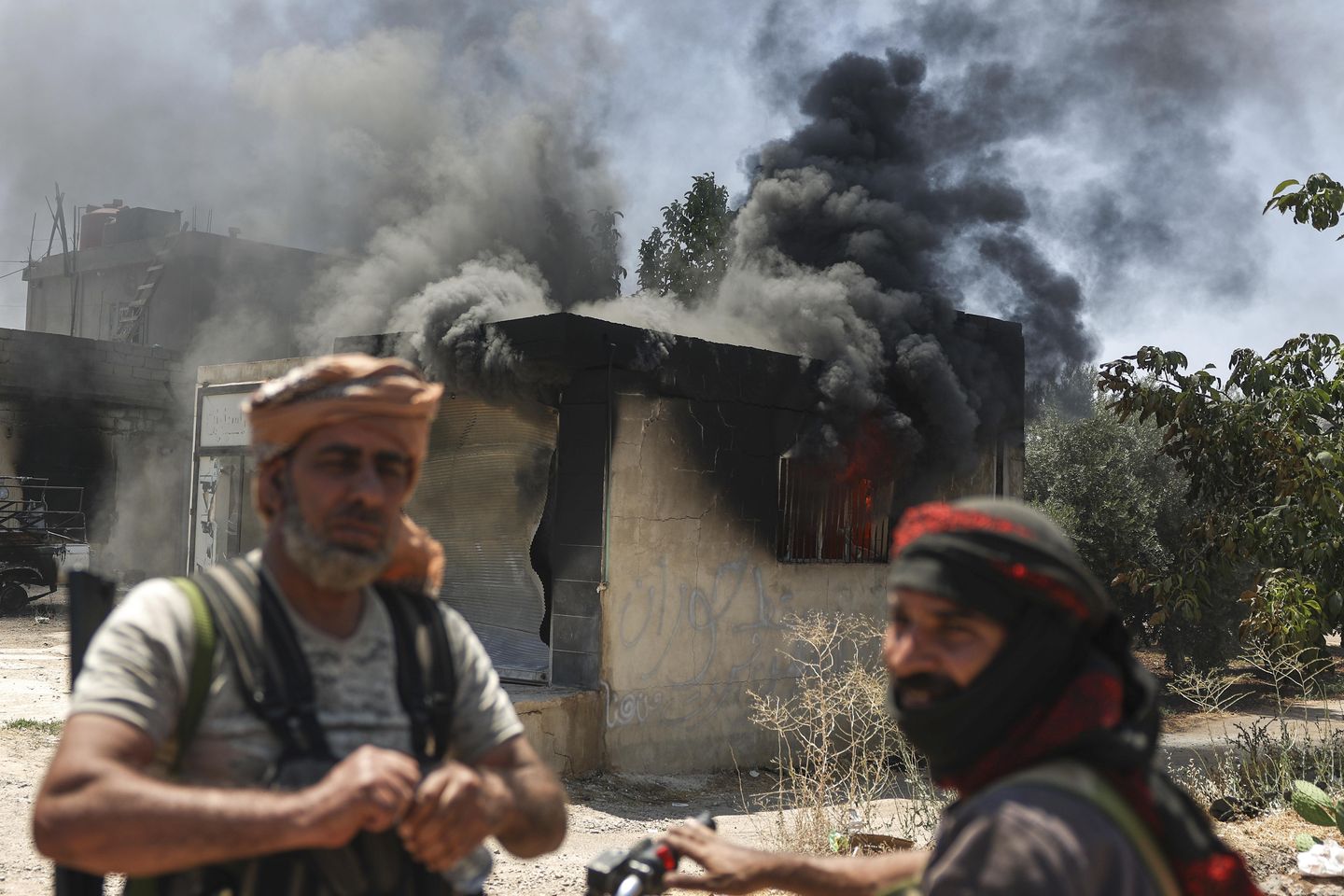
On the outskirts of Sweida, groups of armed Bedouin gathered near buildings that had been set on fire. One individual stated that they had come from the eastern province of Deir ez-Zor to “support the oppressed.”
He expressed a determination to continue fighting until a prominent Druze leader opposed to the government in Damascus, Sheikh Hikmat Al-Hijri, is defeated. He clarified that civilians would not be targeted as long as they remained in their homes.
The Druze religious sect originated in the 10th century as an offshoot of Ismailism, a branch of Shiite Islam. Over half of the world’s approximately 1 million Druze reside in Syria, with the majority of the remainder living in Lebanon and Israel, including the Golan Heights, which Israel captured from Syria in 1967 and annexed in 1981.
While Sweida is predominantly Druze, it also houses Bedouin tribes who are Sunni Muslim. Historically, there have been periodic clashes between the two groups. The current escalation was triggered by an attack and robbery of a Druze man by members of a Bedouin tribe, leading to retaliatory attacks and kidnappings.
A Syrian researcher suggested that there is “no specific reason” for the long-standing tensions between the groups.
He further stated that “All of Syria is full of social problems that have no reason.”
According to him, “The state exploited the latest problem to try to change the situation in Sweida, and this only increased the scope of it.”
In Israel, members of the Druze community had called for intervention to protect the Druze in Syria. However, elsewhere in the region, Druze leaders have rejected Israeli intervention.
The spiritual leader of the Druze community in Lebanon stated that sectarian clashes in Syria “give an excuse for Israeli intervention and for blowing up the situation in the region.”
He emphasized that “We do not accept to request protection from Israel, which we believe is harmful to our history and identity.”
He called for all parties to adhere to the ceasefire agreement and for a national dialogue to address the underlying issues between different communities in Syria.
A Lebanese Druze leader called for the formation of an investigative committee to examine violations against both Druze and Bedouins in Syria.
