

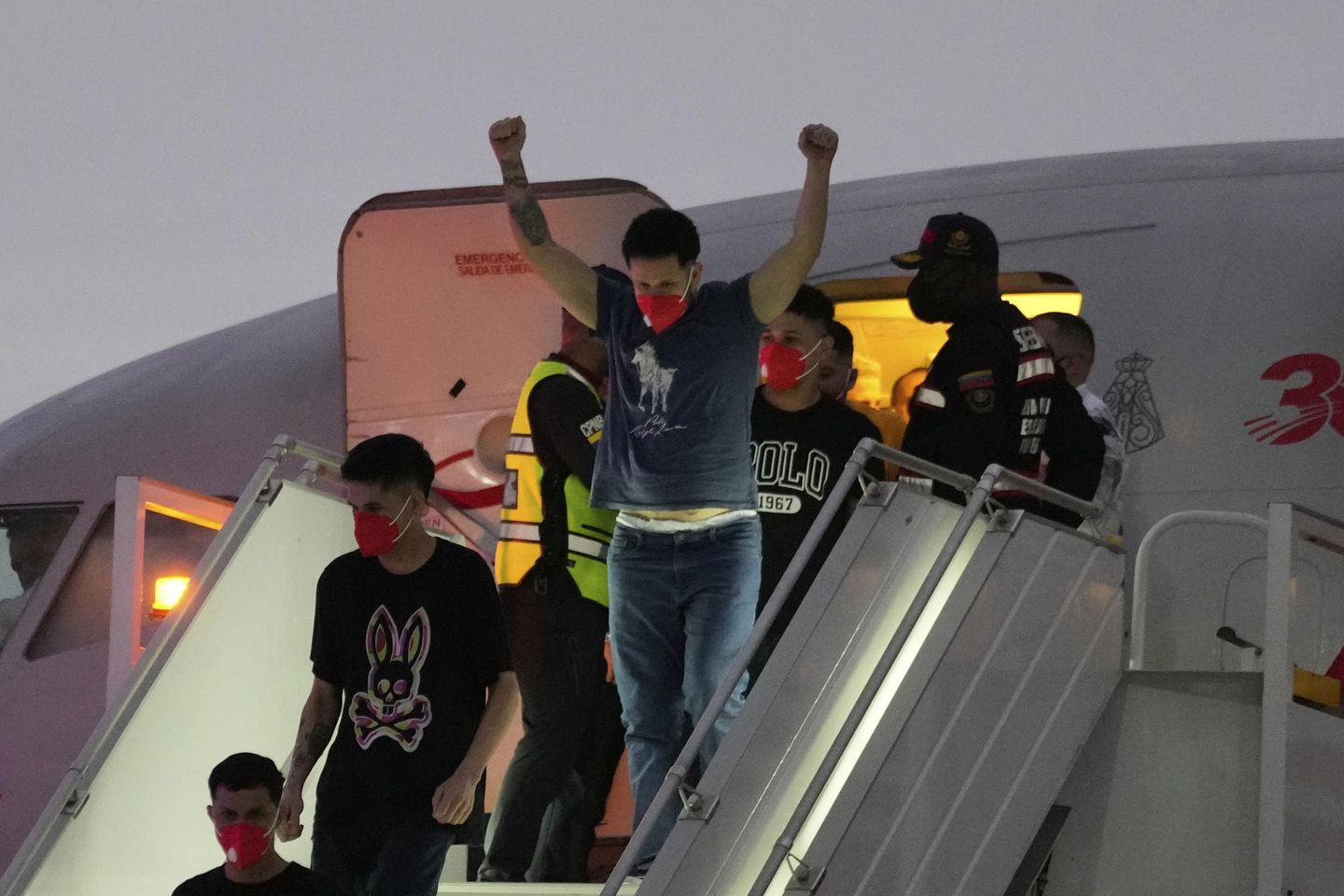
A deported migrant from Venezuela is taking legal action against the U.S. government after being wrongly deported to El Salvador. The migrant alleges that he was subsequently incarcerated in a notorious prison where he suffered abuse. The legal claim arises from an incident where the Trump administration deported a group of Venezuelan migrants to El Salvador, citing the Alien Enemies Act of 1798 and accusing them of being members of the Venezuelan gang Tren de Aragua.
Neiyerver Adrián Leon Rengel, 27, has filed a claim for $1.3 million with the U.S. Department of Homeland Security, claiming that he was wrongly targeted and deported. According to his attorneys, Rengel was taken into custody in Irving, Texas, based on a mistaken assumption that his tattoos indicated affiliation with the Tren de Aragua gang. He had been living in the U.S. since 2023, working as a barber, and had a scheduled immigration court appearance in 2028.
Despite these circumstances, Homeland Security maintains that Rengel was a “confirmed associate” of the Tren de Aragua gang, though they did not provide specific details on how they reached this conclusion. They dismissed his claims as a fabricated “sob story.” The agency asserted the administration’s stance that it would not allow foreign terrorist enemies to operate within the country.
While detained at El Salvador’s Terrorism Confinement Center, or CECOT, Rengel asserts he was subjected to physical abuse by guards, including beatings with fists and batons. He claims that the abuse escalated on one occasion when he was taken to an area without surveillance cameras.
Following his ordeal, Rengel was eventually sent to Venezuela as part of a prisoner exchange. His legal representatives state that he is currently living with his mother and is deeply fearful of returning to the United States. The lawsuit seeks compensation for the emotional and psychological trauma he has endured.
A federal judge had previously ruled that the Trump administration must provide certain migrants deported to El Salvador the opportunity to challenge their deportations. Judge James Boasberg emphasized that these individuals had been denied the chance to formally contest their removals or the allegations linking them to the Tren de Aragua gang. He mandated that the administration establish a process for them to file these challenges.
Judge Boasberg noted the emergence of “significant evidence” suggesting that many of the deported migrants had no connection to the gang and were unjustly imprisoned based on unsubstantiated accusations. At a subsequent hearing, a representative for the Trump administration informed Judge Boasberg that the migrants sent from El Salvador to Venezuela as part of the prisoner exchange would not be immediately returned to the U.S. The decision on whether to allow their return would be contingent on the outcomes of other pending court cases.
Despite Judge Boasberg’s order to turn around planes carrying the accused gang members, the directive was reportedly ignored. Rengel’s attorneys contend that he was on one of these planes. The judge has since found probable cause that the administration may have committed contempt of court. Judge Boasberg also indicated plans to expand his contempt probe to include a recent whistleblower complaint. This complaint alleges that a high-ranking Justice Department official suggested the Trump administration might need to disregard court orders as it prepared to deport the Venezuelan migrants accused of being gang members.
