

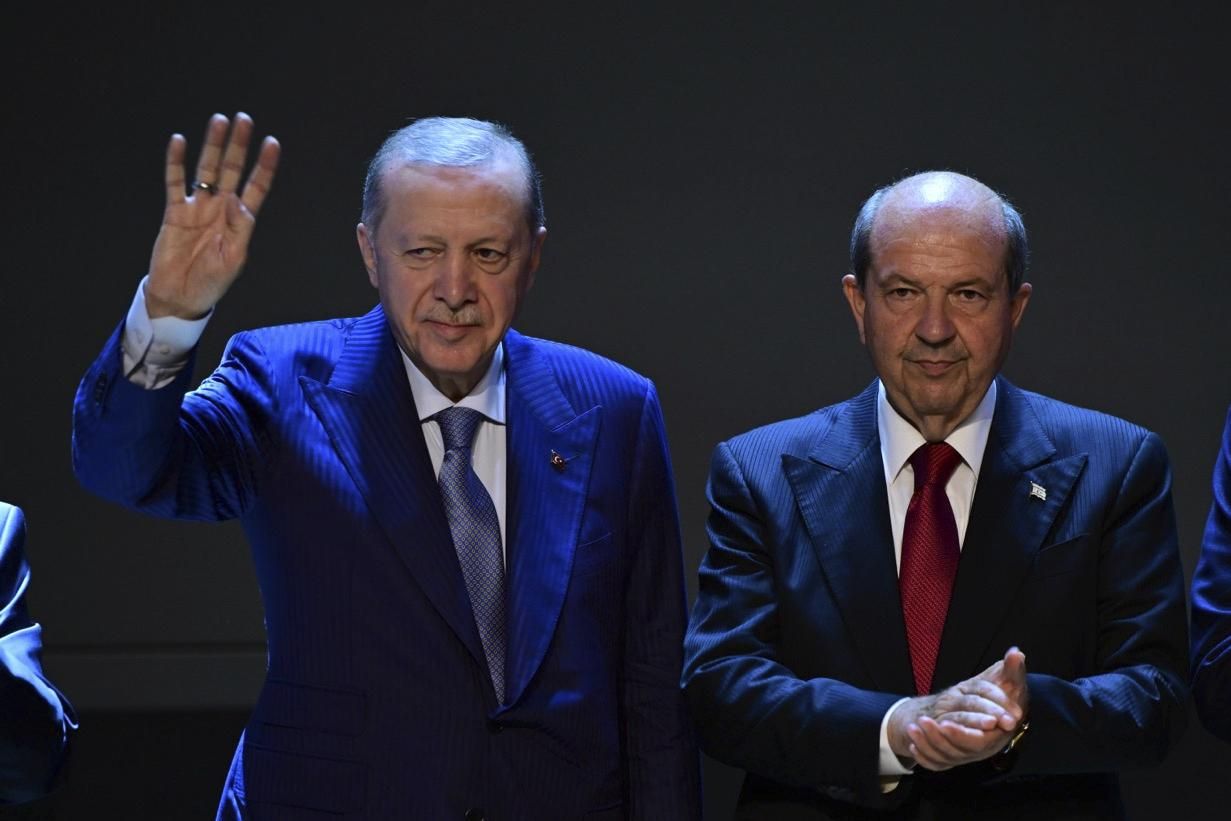
Turkish Cypriots marked the 51st anniversary of Turkey’s military intervention in Cyprus, an event that resulted in the island’s division. The celebrations coincided with renewed support from the Turkish President for a contentious peace agreement that proposes two distinct states.
This two-state solution is largely opposed by Greek Cypriots residing in the internationally recognized southern region of the island. They view it as solidifying the division of Cyprus and granting Turkey a permanent presence, which they fear is a move to control the entire island and its offshore resources.
During the celebrations, which included a military parade, the Turkish President stated, “Our support for (Turkish Cypriot leader Ersin Tatar’s) vision for a two-state solution is absolute.” He also called upon the international community to acknowledge “the facts on the ground” and establish both diplomatic and economic ties with the Turkish Cypriot state, which declared independence in 1983 in the northern third of Cyprus.
Turkey’s military action was prompted by a coup orchestrated by supporters of uniting Cyprus with Greece. To date, Turkey remains the only nation recognizing the Turkish Cypriot declaration of independence and maintains a troop presence of 35,000 in the northern region.
The Turkish President’s renewed endorsement of the two-state solution occurred shortly after a meeting at U.N. headquarters in New York. This meeting included the Greek Cypriot President Nikos Christodoulides, the foreign ministers of Greece and Turkey, and Britain’s minister of state for Europe, all engaging with U.N. Secretary-General Antonio Guterres with the aim of revitalizing peace negotiations after an eight-year standstill.
While the meeting did not achieve a full resumption of negotiations due to the Turkish Cypriot leader’s insistence on recognition of the breakaway state, some progress was made regarding confidence-building measures. These included the exchange of cultural artifacts and the establishment of an advisory committee on civil society.
The U.N. Secretary-General plans to meet with both leaders again in September and organize another broader meeting after the Turkish Cypriot leadership election in October, where the current leader is campaigning on the two-state platform.
Turkey and Turkish Cypriot representatives maintain that a two-state agreement is the only viable path forward. They argue that decades of U.N.-mediated talks aimed at reunifying Cyprus as a federation have proven fruitless.
This shift in stance followed the collapse of peace talks in 2017. Greek Cypriots attributed this failure to demands from Turkish and Turkish Cypriot representatives for a continued Turkish military presence and intervention rights for Turkey, as well as objections to blanket veto powers for Turkish Cypriots on government decisions.
In the southern region, Greek Cypriots commemorated the invasion with memorials for the war dead. The Greek Cypriot President stated that the international community does not support a two-state solution and that Turkey’s continued “occupation of European territory” hinders its aspirations for closer ties with the European Union and its desired role in the region.
